
Mickey & Billy
The Glory & The Tragedy of a Yankee Friendship
By Tony Castro
To be published in 2026 by Diversion Books
Copyright, Diversion Books
PRIDE & PRIVILEGE
New York City, 1950
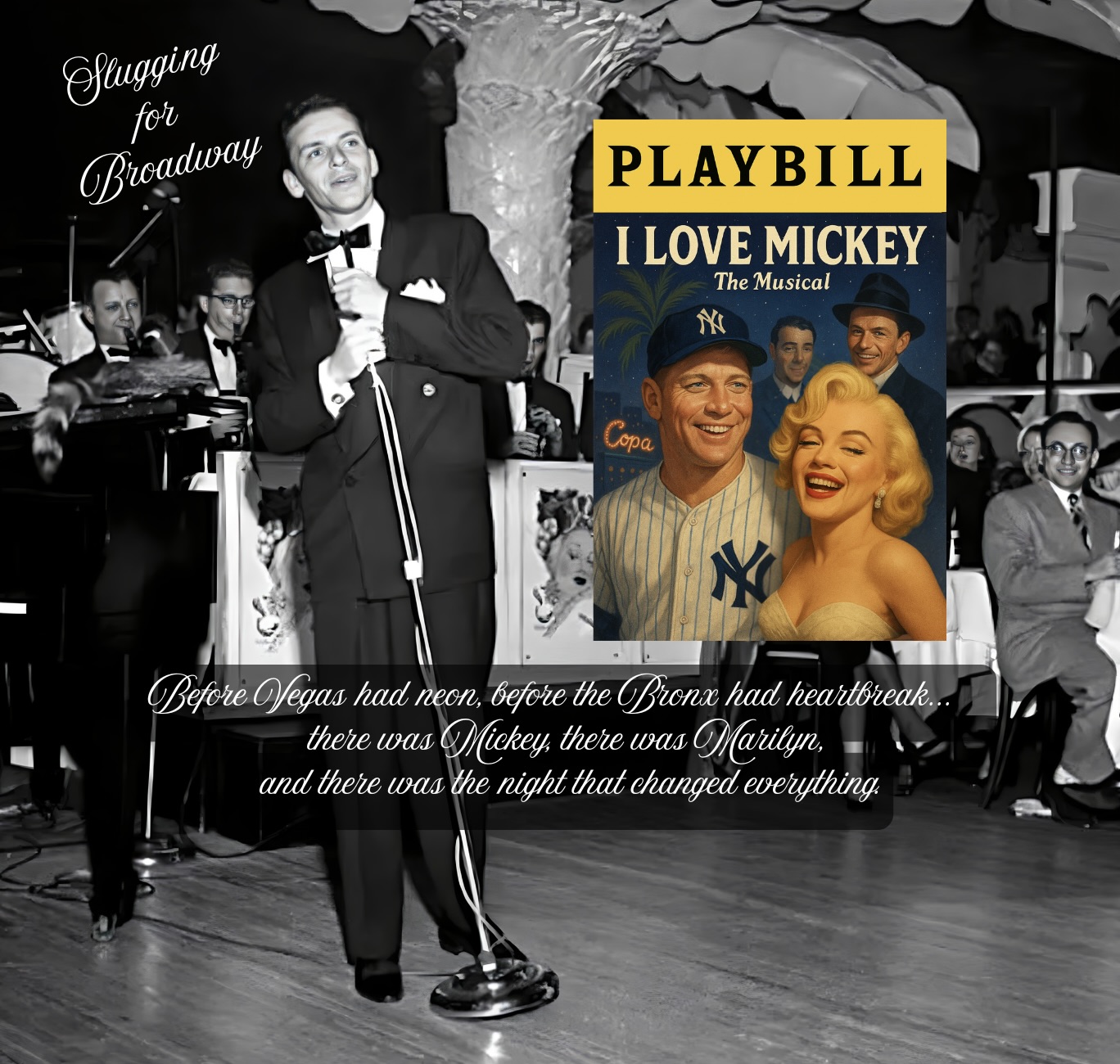
THE EVENING AIR WAS THICK WITH THE KIND of energy that could only come from the city that never sleeps. Neon lights flickered in the distance, and the hum of Manhattan’s nightlife filled the streets. The Copacabana, the legendary nightclub at 10 East 60th Street, was the place to be if you were anyone worth knowing in New York. It was a shimmering world of velvet ropes, white tablecloths, and stars that glittered both onstage and off. Patrons were greeted by tropically-themed Latin decor. There were tiers of palm trees everywhere, and guests were made to feel as if they were in Brazil—a throwback to the massive resort of the same name in Rio De Janeiro that inspired the moniker for the New York club. For Billy Martin, a rookie second baseman for the Yankees, it was a world he was just getting used to, but with a little help from Joe DiMaggio, he was learning fast. And the great Joltin’ Joe knew Billy had the one secret ingredient that was going to help him achieve his dream.
“A ballplayer has to be kept hungry to become a big leaguer,” DiMaggio was fond of saying. “That’s why no boy from a rich family has ever made the big leagues.”
DiMaggio had taken the young Martin under his wing almost immediately after Billy arrived in New York. Both men hailed from California, both were Italian American, and despite the gap in their fame, there was a connection. For Billy, it was more than just a mentor-student relationship—it was like being introduced to a secret club where the perks of being a Yankee were almost as extraordinary as winning the World Series. And tonight, DiMaggio was taking Billy to the Copacabana for his first taste of what it meant to be a true Yankee after dark. And for that, there was no better Yankee to make the introduction to nightlife in New York than DiMaggio.
“There was never a guy like DiMaggio in baseball . . . . Everybody wanted to meet Joe, to touch him, to be around him,” famed New York restaurant Toots Shor once said of <ital>”bella figura,”</ital> as the Italians called DiMaggio. “Joe was a hero, a real legitimate hero. The way he plays, the way he works, the way he is, the way other people related to him.
“Joe could halt business on Fifth Avenue by walking down the street.”
DiMaggio was unusually close to Frank Sinatra, perhaps the biggest headliner at the Copacabana. It had been DiMaggio to whom Sinatra returned for support after his painful break up with Ava Gardner in 1953. In return, the next year Sinatra joined DiMaggio in what became the “Wrong-Door Raid,” as it came to be known, though it was quickly covered up. DiMaggio and Sinatra were having dinner at the Villa Capri restaurant in Hollywood on a November evening when they got the tip: A private eye phoned to say the baseball legend’s estranged wife, Marilyn Monroe, was inside a nearby apartment building, possibly with a lover. Without bothering to pay the bill, DiMaggio stormed out of the eatery, followed by Sinatra and various associates. A few minutes later, the group kicked in an apartment door where they found not Monroe but a lone resident, Florence Kotz, who was in her bed, screaming in terror, witnesses later related, according to author J. Randy Taraborrelli’s book <ital>The Secret Life of Marilyn Monroe</ital>. When DiMaggio finally broke his seclusion from the heartbreak, it was to join Sinatra in catching Andy Williams performing at the Copacabana.
“And Joe said he told Sinatra that he wanted to sit at the exact table where he first told Marilyn he loved her,” Billy later recalled.
And on Billy’s first night there, the Copacabana was everything he had imagined. The low-lit room was alive with the clinking of glasses, the muted laughter of men in sharp suits, and women in cocktail dresses that shimmered under the lights. The world-famous Copa Girls, one of the biggest attractions, were staples of the club. A profile of them in<ital>Life</ital> magazine called them “the most beautiful showgirls currently in New York.” The band was warming up, and a few familiar faces from Broadway and the movie industry were already holding court at their favorite tables. DiMaggio, calm and cool as ever, walked in with the confidence of a man who had done this a thousand times before.
“Stick close to me, kid,” DiMaggio said with a smile, giving Billy a friendly slap on the back. “You’re not paying for a thing tonight. They’ll never give you a bill at this place if you’re with me.”
DiMaggio was sincere about it. Billy said he thought it was because outwardly he was everything that Joe wasn’t. Joe was shy, moody, rarely showing his emotions—and he became even more inward, if it were possible, as he became a big star and protective of his image. Billy, on the other hand, wore his personality and his emotions as if they were pin stripes on his uniform. DiMaggio especially remembered Billy’s first time at bat as a Yankee when he banged a double off Red Sox Pitcher Mel Parnell. It produced a big inning and then Martin came up again with the bases loaded and hit a single.
“Pretty good way to break in, kid,” said DiMaggio. And Joe’s championing of Billy helped to break the ice with some teammates who were slow to concede that he had just taken over the team.
“They tried to ride me,” recalled Billy. “Johnny Lindell—guys like that. All the other rookies would grin and wanted to act as though they liked it, but I gave it back to them. I found out some of them couldn’t take it so good. After a while they left me alone.”
Ah, and then there was Billy’s bravado. When Stengel batted him eighth in the lineup he screamed at his manager: “What is this, a joke? Next thing you’ll be batting me after the groundskeeper.”
So Joe showed him all the ropes, especially those after hours, such as how to enter the Copacabana. The main entrance was at street level. When you entered, the coat room was straight ahead, and to the right was the famous Copa Lounge. The stairs on the left took you down to the basement, which was where the showroom, along with its huge bar, was located. Also, in the basement were two kitchens: one with American cuisine, the other specializing in Chinese food.
Billy grinned. It was good to be in the orbit of DiMaggio, good to be a Yankee. He could feel it already, that invisible aura of fame that came with wearing the pinstripes. The Copa was more than just a nightclub—it was a second home to the Yankees, a place where victories were celebrated, defeats were drowned, and friendships were solidified.
As they were shown to their table—right near the stage where the night’s entertainment was about to start—Billy couldn’t help but take it all in. The Copa had a mystique. This was where Sinatra might swing by after a gig, where Broadway stars rubbed shoulders with ballplayers, where the lights of the New York stage were dimmed only by the brighter glow of the nightlife.
DiMaggio, ever the gentleman, nodded to the maître d’, who knew him well. Within moments, the best champagne was on ice at their table, and Billy watched, wide-eyed, as the waiters moved with the grace of dancers, attending to every detail. The night was just beginning.
“You see, Billy,” DiMaggio said as he took a sip of his drink, “being a Yankee isn’t just about what you do on the field. You’re part of something bigger here in New York. This is where the legends live. The fans adore you, and places like this? They take care of you. You’re family now.”
Billy nodded, trying to act cool, but inside he was buzzing. He was a rookie, just trying to prove himself on the diamond, but off the field? He was learning the ropes of what it meant to be a star in New York.
Martin immediately hit it off with one to the bouncers, Joey Silvestri, who could’ve been his little brother. He was from Queens, who, even at his young age, was responsible for determining who got into the Copacabana, as well as keeping them in line once they were there. Joey also took care of the special entertainers, among them Sammy Davis Jr., whom he had befriended. And also Joe DiMaggio and whoever happened to be with him. You might even have been able to say that at the Copacabana Joey Silvestri was its Billy Martin: undersized but tougher than any other guy around. He grew up to become one of New York’s most respected mafia muscle man. They called him Joey “The Fixer” because he had a talent for making problems go away. In his book, <ital>A Family Business: The Life and Times of Joey “The Fixer” Silvestri</ital>, Joey wrote that he knew how to use his fists when necessary, and he always followed Mob protocol when having a sit down with an adversary: “You never break bread with the enemy.”
“I’ve been fighting since I’m 14 or 15 years old,” Silvestri loved to say. “I had more fights than, say, Rocky Marciano, for cryin’ out loud.”
So Joey was the perfect bouncer to have at the Copa whenever a big headliner, such as Frank Sinatra, entered or exited, when he and another guard locked their fists over his head like a tiara. Or like whenever Sinatra had to relieve himself, Joey went on ahead, chasing out everyone from the men’s room so he could have the place to himself.
And on that first night, Billy would later recall, the evening rolled on with the band playing Big Band hits, and the floor show kicking into high gear. Showgirls twirled and glided across the stage, their sequined outfits flashing in the lights, while the crowd cheered and clapped. At the Copa, everyone was somebody, and for Billy, that realization came with every passing minute.
As the hours slipped by, Billy and DiMaggio found themselves surrounded by friends, new and old. Broadway stars drifted to their table to chat with DiMaggio, who was a god in this town. Movie stars, lounge singers, and the big names from New York’s upper crust mingled around them, treating them like old friends. Billy, though young, was catching on quickly. He didn’t need to pay for a drink. He didn’t need to worry about anything. The Copa looked after its Yankees.
It was no secret that the Copacabana had Mob ties. So, too, did a number of other nightclubs in Manhattan. In <ital>Joe DiMaggio: The Hero’s Life</ital>, the late Pulitzer Prize-winning author Richard Ben Cramer detailed Joe’s ties to the Mafia including that mobster Frank Costello set up a “trust fund” for DiMaggio at the Bowery Bank, to which was regularly added funds every time DiMaggio made an appearance at nightclubs like the Copacabana, the Stork Club, and El Morocco. “Costello loved Joe,” Cramer told the <ital>New York Daily News</ital>, “and he felt it was the gentlemanly thing to do—to put a couple of bucks in the Bowery for Joe’s retirement. Of course, the irony of this arrangement is that years later, Joe did all those commercials as the spokesman for The Bowery. When he told us how safe your money was with The Bowery, he knew what he was talking about.”
No wonder that DiMaggio might have felt so invincible; by midnight on his evening out with Joe, Billy was feeling invincible, too. He had already decided that the Copa was going to be his second home, just like it had been for DiMaggio. “This is the life,” he thought to himself as the band played a slow tune. The champagne was flowing, and the buzz in the room was electric.
As the crowd began to thin out, DiMaggio leaned in and said, “There’s more to the night, kid, if you can handle it.” He gestured toward the door, where a guard stood ready to escort them to wherever Joe wanted to go. Sometimes, as he had recently, Joey Silvestri escorted him and his friends, including Harry Belafonte and Sidney Poitier, to the bar of the Hotel Fourteen next door. On this night, DiMaggio wanted to go to the Harwyn Club on East 52nd Street, a quieter, more exclusive spot where the night could continue in style.
Billy was hooked. “Let’s go,” he said with a grin.
The two of them, along with a few other Yankees who had drifted in after the game, made their way through the dim streets of Manhattan, laughing and joking as the guard led them to their next stop. The city was quiet now, the hustle of the day games behind them, but for Billy and the Yankees, the night had only just begun.
The Manhattan night air was crisp as Billy Martin and Joe DiMaggio stepped out of the Copacabana, escorted by their ever-attentive guard. The lights of the city twinkled around them, and though the streets had quieted compared to the bustling hours earlier, there was still a pulse. This was New York City after all—a city that never truly slept, not even in the small hours of the morning. For Billy, still riding the high of the Copa, the night felt like it could stretch on forever.
“Harwyn Club’s a little quieter,” DiMaggio said as they made their way down the sidewalk. “Not as much fanfare, but still exclusive. You’ll like it.”
Billy grinned, his head buzzing with the champagne, the excitement, the sense of belonging that came with being in DiMaggio’s company. Just a rookie, and now he was living like a king. “How often do you do this?” Billy asked, almost incredulous.
DiMaggio gave him that signature smile, the one that said he’d been doing this long enough to know the ropes. “Every chance I get,” he replied, glancing up at the towering buildings as they passed. “You play hard for the Yankees, you earn the right to live a little. This is New York. The lights, the people, the clubs—they all treat you like royalty. And if you’re a Yankee? Forget about it. The city bends over backward for you.”
The Harwyn Club, tucked away on East 52nd Street, had an understated elegance compared to the flash of the Copa. But it was also the club which would become internationally famous a few years later as the place where Grace Kelly and Prince Rainier of Monaco held their engagement party. The orchestra at the Harwyn Club played a special song for the Prince and Princess, “Your Eyes Are the Eyes of a Woman In Love,” a song they loved from the beginning of their romance. In the coming years, the Harwyn Club would also be a favorite of Joe DiMaggio and Marilyn Monroe during their courtship and where they were often seen during their time in New York.
On this night, a low-key jazz quartet was playing softly as they entered, the kind of music that swirled around the room like the final sip of a smooth whiskey. The club had the feel of an exclusive retreat—no blaring horns, no showgirls, just dark wood paneling, leather chairs, and men in tailored suits who all seemed to know exactly who DiMaggio was from the moment he walked in. He had been a cultural icon in New York since who is fabulous rookie season in 1936, and he was now arguably the most recognizable man in America.
They were ushered to a corner table, and as they sat down, DiMaggio ordered them two bourbons without even asking Billy. “You’ll learn to love the late nights,” he said as the waiter walked away. “Being a Yankee means you don’t just live for the game. You live for the moments like this. The city’s ours.”
Billy leaned back, taking it all in. The Harwyn Club was quieter, but there was a magic in the stillness, in the soft murmur of conversations between the city’s elite. He looked around the room and caught sight of a few faces he recognized from the papers—actors, businessmen, the kind of people who were always somewhere in the background of Yankee lore. But now, they weren’t in the background. They were sitting just a few tables away, part of the same world Billy had been swept into.
In the years to come, the Harwyn Club would become a special favorite of his in New York nightlife. It was less of a Yankee hang out and environment than clubs lke the Copa, which made it especially easier when he returned to New York as a member of other teams. In 1959, when he was with the Cleveland Indians, Billy brought his teammate Rocky Colavito and his wife to the Copa to celebrate his engagement to airline hostess Gretchen Winkler, whom he married in Rome in 1961. But that was another story.
On this night, he was learning the ropes from DiMaggio. Joe, ever the sage, sipped his bourbon and smiled. “You’ll be doing this for years, Billy. You’ve got the talent, the grit. And don’t forget—this town loves a ballplayer who knows how to handle himself.”
Billy chuckled. “I never thought playing baseball would lead to this. Back home, a big night out was a beer and a burger after a game. This . . . this is something else.”
“New York’s different,” DiMaggio said, his voice low and smooth. “Here, the lights never go out. And if you’re wearing pinstripes, those lights are always shining on you.”
The hours slipped away at the Harwyn Club, the bourbon doing its job, the slow jazz lulling them into a contented silence. But Billy was still buzzing, still riding the high of the night. As they finally stood to leave, DiMaggio looked at his watch. “Almost 4 a.m.,” he said casually, as if it were the most natural thing in the world. “We’ll grab a car back to the St. Moritz. You’ll be fine. Sleep in, show up at the ballpark whenever you’re ready. That’s the life.”
Billy felt a surge of disbelief. He was living the dream. “You don’t worry about missing curfew?”
DiMaggio chuckled. “Curfew’s for rookies who haven’t earned their stripes. You’re with me now, kid. Just be at the ballpark by the time the first pitch is thrown, and you’re golden.”
They stepped out of the Harwyn Club into the still-dark streets, but the glow of New York was everywhere. Billy looked up at the towering buildings, the flickering lights, the distant hum of taxis making their rounds. The city was endless, and so was the night.
As they drove back to the St. Moritz Hotel, where DiMaggio had arranged for Billy to stay alongside the rest of the team, Billy felt an odd mix of exhilaration and calm. This was the life he’d dreamed about. And if Yankee Stadium was their cathedral during the day, then the St. Moritz was their private sanctuary at night.
The car pulled up to the hotel, and DiMaggio gave Billy one last look. “Remember this feeling,” he said. “There’s nothing like it. You’ll play in cities all over the country, but none of them will treat you like New York does. The city’s alive for you, as long as you’re wearing those pinstripes.”
Billy nodded, stepping out of the car and into the cool morning air. He watched as DiMaggio walked ahead of him into the grand lobby of the St. Moritz, every inch the legend that he was. Billy followed, the night still swirling around him, knowing that tomorrow would bring another game, another moment in the sun, and then—after the crowds had gone home—another night where New York waited for him, ready to embrace its Yankee heroes once again.
They didn’t need to worry about batting practice. That was for the other guys. The ones who didn’t have their names carved into the fabric of the city. For Billy and DiMaggio, all they had to do was show up by game time. For a Yankee, especially one with DiMaggio at his side, the rules bent to the rhythm of the night, and the city never stopped playing.
Billy couldn’t help but think about how different his life had become. From playing baseball in dusty California ballparks to rubbing elbows with the elite in New York’s most exclusive clubs: it was like stepping into a dream. He owed it all to DiMaggio, to the Yankees, and soon enough, he’d pay it forward. He’d bring Mickey Mantle into this world, just as DiMaggio had brought him. Because if you were a Yankee, this was your birthright—the lights, the music, the clubs, and the feeling that you were invincible.
And the Copa? Well, that was just the beginning. But what a beginning it was, and one that he would pass on to Mickey. Mantle would boast that it was easier to pick up a beautiful woman at the Harwyn Club than in any other place in New York. He would simply have the maître d’ walk over to the girl who had caught his eye and say, “Mr. Mantle wants to meet you.”
There would be an invitation to Mickey’s table, and he loved the flirtation that went with it. Marjorie Boulding, an aspiring actress, writer and Southern belle from Birmingham, who in 1956 telling the maître d’, “Well, I don’t know who Mr. Mantle is. I’m sorry, I don’t go to anybody’s table. If he wants to meet me, he’ll have to come to my table.”
Bolding soon went to the little girls’ room, getting the surprise of her life when she stepped out of the stall and saw Mickey standing there with his hand across the door.
“You’ve got the prettiest blue eyes I ever saw,” he said.
Bolding responded with the first thing she could think of. “Do you really smoke those cigarettes?” she asked, remembering having seen Mantle on television, advertising Chesterfield or Camel cigarettes
“Nah,” said Mickey wearing that winning crooked grin of his. “I don’t smoke.”
Mickey homered, by the way.
“There were [times] I don’t think we got out of the limousine for two days!” Bolding later said. “He was the most fun. Nobody could play ball like Mickey, and nobody could play like Mickey.”