
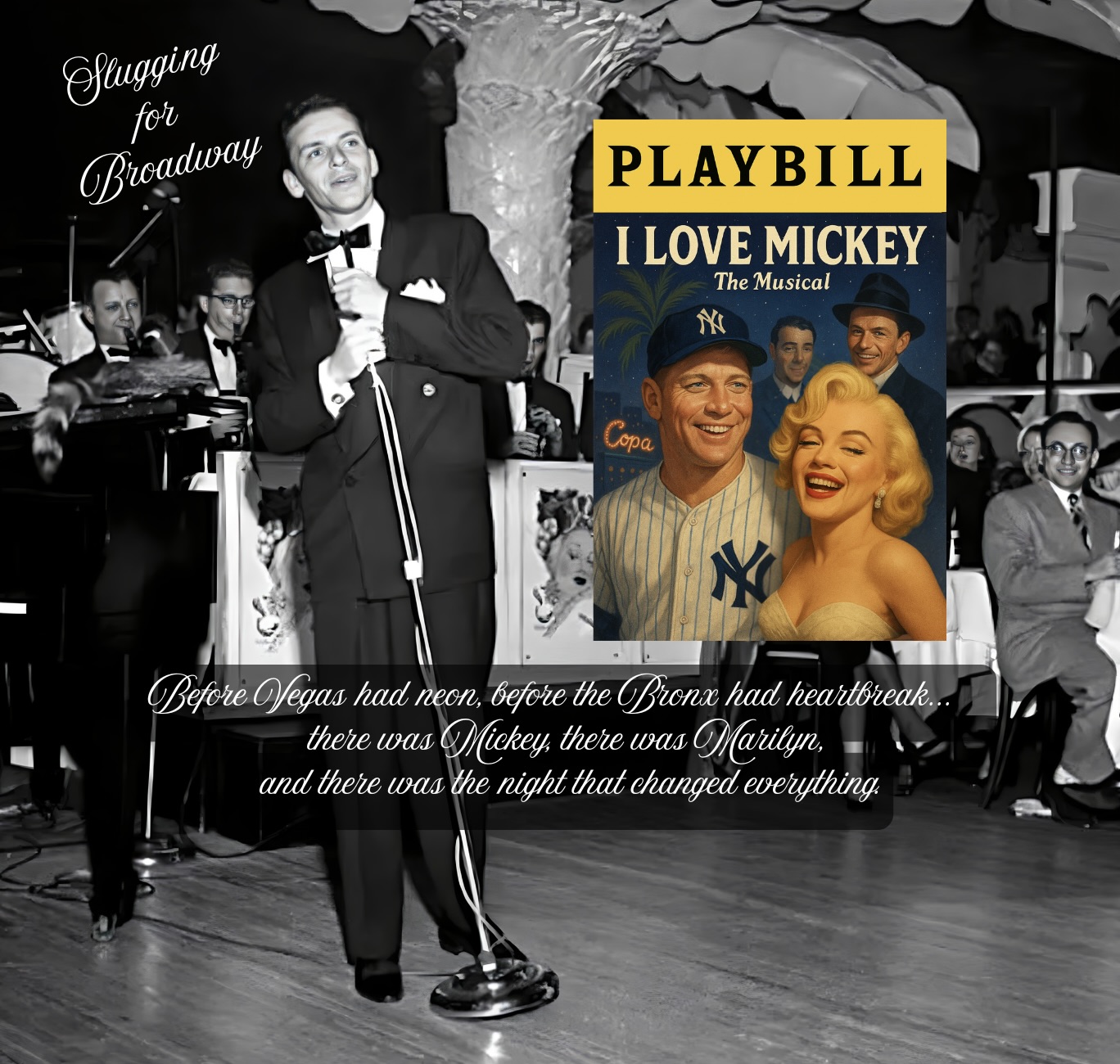

Ultimately, ‘I Love Mickey’ is a love letter to New York, to the mythology of the Yankees, and to the fleeting, glorious magic of youth under the lights — on the field and off.
I Love Mickey is a jazz-kissed, emotionally charged musical set in 1950s New York—where the Yankees ruled the diamond by day, and the Copacabana sparkled by night. Inspired by author Tony Castro’s bestselling biographical series of Mickey Mantle, the show reimagines the Golden Age of baseball and the glitter of showbiz through the lens of youthful glory, forbidden love, and mythic fame.
But this isn’t your grandfather’s baseball musical. As Joe DiMaggio’s storied career winds down, a charismatic, golden haired Mickey Mantle steps into the spotlight, guided by his fiery sidekick Billy Martin and caught in an unexpected romantic entanglement. I Love Mickey spins an alternate history where Marilyn Monroe doesn’t fall for DiMaggio—she falls for DiMaggio’s younger, heroic successor. Where the Copacabana is more than a nightclub—it’s sequins on skin, gin in crystal, and a velvet hush just before a mob deal goes down.
…Where Marilyn Monroe doesn’t fall for DiMaggio—she falls for Mickey Mantle.
Think Hamilton swaggering in Rat Pack cufflinks, Guys and Dolls sipping bourbon with Once Upon a Time in Hollywood. With over 40 original songs—crooned, belted, and whispered in alleyways—I Love Mickey dives deep into the mythology of America’s pastime and the seductive, dangerous dream of mid-century fame.
At its heart is Marilyn — not the bombshell, but the woman, the voice, the heartbreak. Her torch songs light the shadows of every scene. Sinatra smolders backstage with Ava Gardner. Billy Martin preaches like a street-corner prophet of the baseball underworld. And Mickey? Mickey becomes a myth not written in stats, but carved into legend.
The story unfolds in a reimagined Gotham—glimmering with glamour and pulsing with danger—where Mickey Mantle isn’t merely a sports star, but a symbolic figure of national hope. Marilyn becomes the embodiment of longing, elusive and radiant. And threading through their world are the forces of organized crime, not just lurking, but shaping destinies—from the Bronx to Beverly Hills. This tension—between spectacle and surveillance, grace and corruption—drives the emotional engine of the show.
With appearances by Frank Sinatra, Ava Gardner, Sammy Davis Jr., Copa owner and mob boss Frank Costello, and a chorus of showgirls, sportswriters, and Yankee brass, I Love Mickey blends Rat Pack swing, Broadway bite, and baseball romance. The music swings, swoons, and punches like a fastball. It’s a love letter to New York, a glittering elegy to youth, and a fierce celebration of America’s flawed but unforgettable idols.
The musical also confronts a deeper cultural paradox: why a society so quick to cancel in the present remains enthralled by the flawed legends of its past. Mickey’s alcoholism, Marilyn’s mental anguish, Sinatra’s temper—these weren’t private struggles. They were messy, public, and painfully human. And yet, America embraced them. Was it their beauty, their talent—or something deeper? Perhaps their wounds made them more real. Perhaps we needed to believe in something transcendent that still bled like us.
Inspired by the casting freedom of Hamilton, I Love Mickey actively encourages actors of color, queer performers, and artists from historically excluded communities to step into these mythic shoes. Mickey doesn’t have to be white. Marilyn can be a gospel-trained Black woman. These roles belong to whoever can sing their souls into them.

Tone & Style: Big-band Broadway meets noir cabaret. Think Hamilton meets Damn Yankees meets Guys and Dolls, with nods to The Godfather and A Bronx Tale.
Target Audience: Baseball lovers, musical theater fans, vintage New York nostalgia seekers, pop culture buffs, and dreamers of all stripes.